Busting Myths About High Risk Pregnancy with Dr. Stu Fischbein, MD #highriskpregnancy
Fertility mindset coach Rosanne Austin interviews Dr. Stuart Fischbein to debunk myths about high-risk pregnancy labels and empower women with evidence-based information about natural birth.
Teachings 6
The term 'high risk pregnancy' has no medical definition and is often used as a fear tactic rather than meaningful medical information
Dr. Stuart Fischbein explains that ACOG considers pregnancy itself to be high-risk, meaning virtually every pregnant woman gets labeled as high-risk for arbitrary reasons like being over 35, having twins, or previous IVF
VBAC carries only a 1 in 1,200 risk of serious complications—the same risk as Down syndrome at age 25, yet no one calls 25-year-olds high-risk
Dr. Fischbein breaks down the actual mathematics: 1 in 200 risk of uterine separation times 16% risk of bad outcome equals 1 in 1,200 actual risk
Constant fear and stress during pregnancy bathes the developing baby in cortisol and adrenaline instead of beneficial hormones like oxytocin
Dr. Fischbein explains how fear-based prenatal care creates chronic stress that affects fetal development through stress hormone exposure
Midwifery care with 30-60 minute visits produces better outcomes than 6-8 minute OB visits, including lower rates of gestational diabetes and hypertension
Dr. Fischbein compares outcomes between midwifery model of care focused on prevention versus medicalized model focused on problem management
The Friedman curve used to justify labor interventions is fundamentally flawed because it labels 50% of women as dilating 'too slowly' by mathematical design
Dr. Fischbein explains that the curve represents an average, meaning half of all women naturally fall below it—making normal variation appear pathological
Women must question medical interventions and demand evidence-based reasoning rather than accepting fear-based recommendations
Austin and Dr. Fischbein emphasize that patients have the right to challenge unnecessary procedures like routine color Doppler ultrasounds and excessive monitoring
Quotable Moments 4
“High risk is something that makes your obstetrician uncomfortable. Period.”
— Dr. Stuart Fischbein“The design is perfect. Doesn't always work, but the design is perfect.”
— Dr. Stuart Fischbein“Whatever brought this baby to me is gonna see it through. Like, I just refused to take those labels on.”
— Rosanne Austin“You can't make an informed decision if you're not given honest information.”
— Dr. Stuart Fischbein
Questions This Video Answers
What does high-risk pregnancy actually mean medically?
“High risk is something that makes your obstetrician uncomfortable. Period.”
— Dr. Stuart Fischbein
High-risk pregnancy has no official medical definition and often means nothing more than what makes your doctor uncomfortable. True high-risk conditions like placenta previa require intervention, but being over 35 or having twins doesn't automatically make you high-risk.
How safe is VBAC compared to repeat cesarean?
“The actual risk of any woman going into, deciding to have a VBAC after a single low transverse cesarean of having a ruptured uterus leading to a really bad outcome is one in six times one in two hundred or one in twelve hundred.”
— Dr. Stuart Fischbein
VBAC has only a 1 in 1,200 risk of serious complications—equivalent to Down syndrome risk at age 25. This is significantly safer than multiple repeat cesareans, which carry cumulative risks including placenta accreta and hysterectomy.
Should I avoid home birth if I'm over 35 or having twins?
“Just because you're over thirty five does not make you high risk. Just because you have a high BMI does not make you high risk.”
— Dr. Stuart Fischbein
Age over 35 or twins alone don't make you high-risk until actual complications develop. Home birth can be safe for healthy women with proper screening, regardless of age. Even some twin pregnancies can be safely managed at home with experienced providers.
How does fear during pregnancy affect my baby?
“All this time, the woman is growing a baby inside of her, constantly bathing the baby in the stress hormones of cortisol and adrenaline, and not the dopamine and oxytocin that they should be bathing their babies in”
— Dr. Stuart Fischbein
Chronic fear and stress during pregnancy expose your developing baby to cortisol and adrenaline instead of beneficial hormones like oxytocin. This stress hormone environment can impact fetal brain development and overall health.
Watch on YouTube
Key Points 6
The term 'high risk pregnancy' has no medical definition and is often used as a fear tactic rather than meaningful medical information
VBAC carries only a 1 in 1,200 risk of serious complications—the same risk as Down syndrome at age 25, yet no one calls 25-year-olds high-risk
Constant fear and stress during pregnancy bathes the developing baby in cortisol and adrenaline instead of beneficial hormones like oxytocin
Midwifery care with 30-60 minute visits produces better outcomes than 6-8 minute OB visits, including lower rates of gestational diabetes and hypertension
The Friedman curve used to justify labor interventions is fundamentally flawed because it labels 50% of women as dilating 'too slowly' by mathematical design
Women must question medical interventions and demand evidence-based reasoning rather than accepting fear-based recommendations
Related Videos
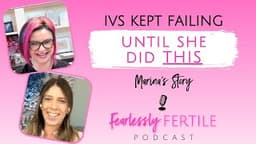
IVF Kept Failing until She Did THIS #ttcjourney #ivfsuccess #ttc
After 9 IVF cycles and 15 embryo transfers failed, Marina conceived at 40 when she stopped making decisions from fear and started living joyfully again.

Fertility Limits Don't Apply to ME: Sarah's Story
How a 44-year-old naturopathic doctor went salsa dancing the night before her embryo transfer and conceived twins.
Related Podcast Episodes
250th Episode Celebration!
What happens after you bring your miracle baby home? Past Miracle Mamas reveal how the fearlessly fertile mindset continues transforming their lives years later.
EP284: From “No Chance” to Baby At 47: Heather’s Story
Discover how Heather defied medical predictions and conceived naturally at 46 after being told she had 'no chance' at 41.
EP257 Taking the Fear Out of Birth + Baby Making with Dr. Stu Fischbein, MD
A maverick OB reveals why the medical system fears birth more than women do - and how to reclaim your power during pregnancy.
EP93 At 44 She Had A Less Than 1% Chance…and Succeeded…Naturally
At 44 with less than 1% odds, Anu proved everyone wrong and conceived naturally - here's exactly how she did it.